
By Dear Ole Shaneaux!
Alright, finally for the first and ONLY time in my career. I’m going to discuss what I call ‘my faith.’ In the Summer of 2016, I was in the midst of the Summer session at Hinds Community College where I was taking my first of what would be come three philosophy courses.
This was also the first of three times I sat under the instruction of the legendary Stephen Wedding. Now rookie me, was a bit too cocky for my own britches. Long story short, he humbled me.
By the end of that course, I understood the Allegory of the Cave, The Divided Line, and the Symposium. While I got the answers (or at least some) to Classical Western Philosophy, I found myself coming up with more questions.
I grew up Christian, you see and you know the rules to that, no need to explain. But around the age of 16, I began to wonder more about other religions and practices. While I’m not going to say which religions, I will say some of the things I learned helped me develop a respect for their cultures.
Six years later at 22, those learnings, couple with the philosophy course yielded questions about the existence and true knowledge of the man called God.
But first, for the final fucking time for those in the back, here’s what agnosticism means.
What Is Agnosticism?
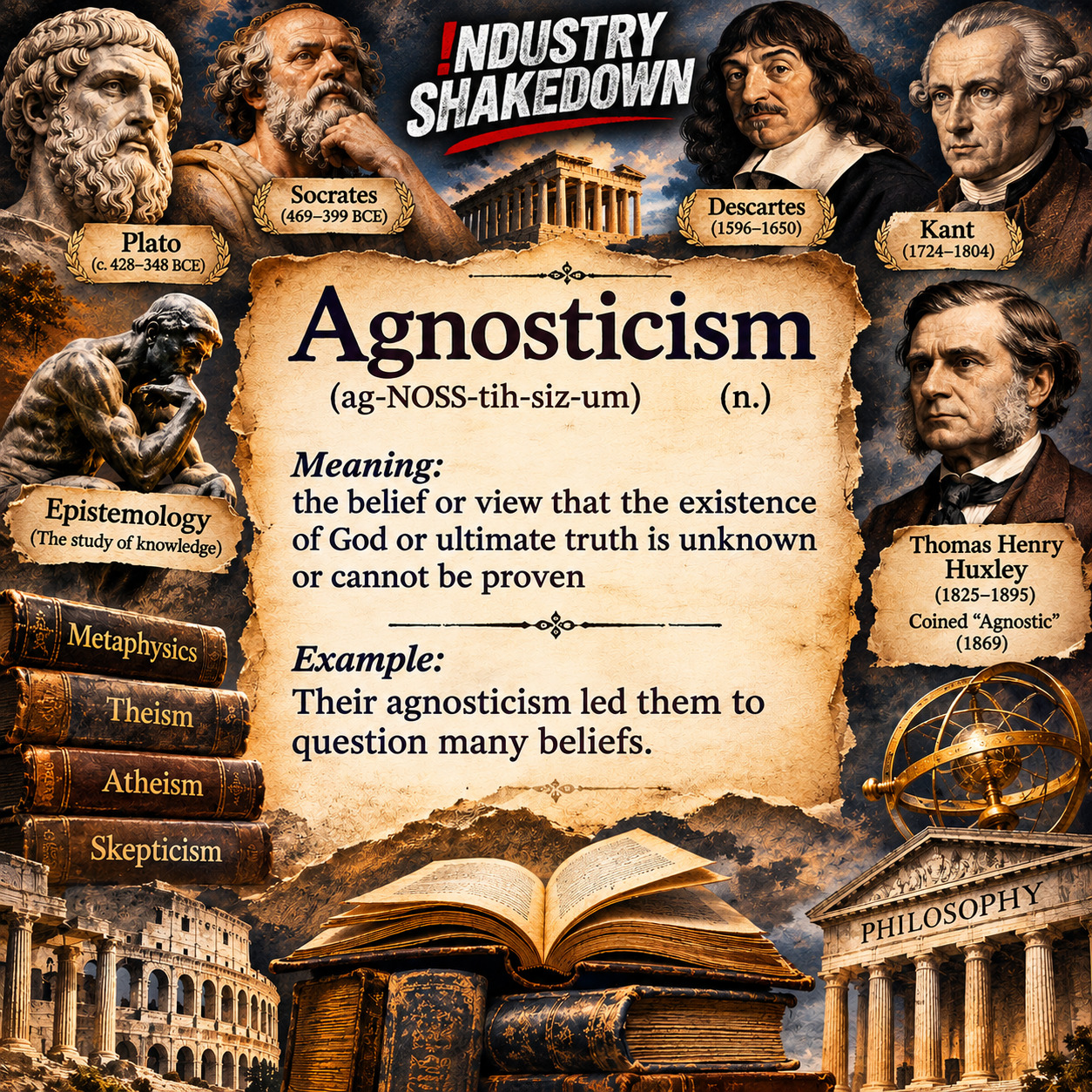
Agnosticism is generally defined as the view that the existence or nature of God, gods, or some ultimate divine reality is unknown or potentially unknowable.
Sounds simple enough, right?
Well, not exactly.
You see, agnosticism isn’t necessarily one rigid position. It can take several different forms, and understanding those differences is important before we go any further.
Let’s break this down.

1. “I Don’t Know.”
This is perhaps the simplest expression of agnosticism.
A person may acknowledge that they personally don’t have enough evidence to reach a definitive conclusion about God’s existence while remaining open to learning more.
In other words, they’re not necessarily rejecting the possibility that God exists. They’re simply acknowledging that they haven’t encountered enough convincing evidence to claim otherwise.
2. “We Don’t Know.”
Now we’re moving beyond individual uncertainty.
This position holds that humanity has not conclusively established whether God exists, although that doesn’t necessarily mean we’ll never find an answer.
Notice the distinction.
Someone saying, “I don’t know,” is acknowledging the limitations of their personal knowledge. Someone saying, “We don’t know,” is making a broader claim about humanity’s collective understanding.
Of course, some religious believers maintain that they possess knowledge of God through faith, revelation, or personal religious experiences.
The disagreement, then, isn’t always about whether someone believes they’ve encountered God. It’s also about what qualifies as knowledge and whether those experiences provide sufficient evidence to establish a claim beyond the individual experiencing them.
3. “We Cannot Know.”
Now this is where things become particularly interesting.
A stronger form of agnosticism holds that God’s existence, or certain aspects of the divine, may lie beyond the limits of human knowledge altogether.
Under this interpretation, the issue isn’t simply that we haven’t discovered the answer yet. It’s that human beings may lack the capacity or means to establish such knowledge in the first place.
However, there’s an important distinction here.
Claiming that something is currently unknown is not the same as demonstrating that it is fundamentally unknowable.
And that stronger claim requires an argument of its own.
These three expressions are useful ways of understanding different agnostic positions, not three universally established philosophical categories.
Someone who says, “I haven’t found a convincing answer,” is making a different claim from someone who insists, “No human being could ever know.”
Related positions? Absolutely.
Identical? Not even close.
Let’s Go a Bit Deeper Now.
Here’s where a considerable amount of confusion comes into play.
Agnosticism is commonly described as a position concerning knowledge, while theism and atheism are generally discussed in relation to belief.
Now, those distinctions aren’t always applied identically in academic philosophy and everyday conversation, but understanding them can help clear up some common misconceptions.
Let’s establish a few definitions.

Theism — The belief that at least one God or deity exists.
Atheism — The absence of belief in gods or, in a narrower philosophical sense, the belief that no gods exist.
Agnosticism — The position that the existence of God or gods is unknown, uncertain, or potentially beyond human knowledge.
Agnostic Theism — Believing that God exists while acknowledging that one does not possess certain knowledge of God’s existence.
Agnostic Atheism — Lacking belief in God while acknowledging that one does not know with certainty whether a god exists.
See the difference?
A person can believe something without claiming to know it with certainty. Likewise, someone can withhold belief without claiming to have proven that the thing in question doesn’t exist.
Some people identify simply as agnostic because they’re undecided about belief itself, because neither theist nor atheist adequately describes their position, or because they prefer not to adopt either label.
And that’s perfectly consistent with how many people use the term in everyday life.
The important thing to understand is that belief and knowledge are related concepts, but they are not interchangeable.
What Agnosticism Does — and Doesn’t — Say.
Now that we’ve established the terminology, let’s clear up a few misconceptions.
Being agnostic doesn’t automatically mean someone believes God doesn’t exist.
It doesn’t mean they consider every religion equally true.
And it certainly doesn’t mean they don’t care about religion.
An agnostic individual might pray, attend religious services, study theology, explore different spiritual traditions, or maintain no religious practices whatsoever.
Furthermore, agnosticism doesn’t require someone to treat every religious claim as equally plausible.
A person can find one explanation more convincing than another while acknowledging that their conclusion remains uncertain.
Recognizing the limitations of your knowledge doesn’t require abandoning your ability to evaluate evidence.
And that brings us to an important historical figure.
Thomas Henry Huxley and the Origins of Agnosticism.

The term agnostic was coined in 1869 by British biologist Thomas Henry Huxley, a prominent defender of Charles Darwin’s theory of evolution.
Huxley wasn’t simply searching for another word to describe someone who didn’t believe in God.
He was articulating a principle of intellectual inquiry: people should not claim certainty about matters they cannot adequately justify through reason and evidence.
For Huxley, agnosticism wasn’t necessarily a religious creed or an alternative system of worship. It was a method of approaching questions about what human beings could reasonably claim to know.
That distinction is important.
Rather than beginning with a predetermined conclusion, the agnostic approach encourages individuals to examine the available evidence, recognize the limitations of their understanding, and resist presenting uncertain conclusions as established facts.
Now, this doesn’t mean every agnostic follows Huxley’s philosophy in precisely the same way.
Nor does it mean that religious belief and intellectual honesty are mutually exclusive.
Religious philosophers have spent centuries developing arguments concerning God’s existence, the nature of faith, and the relationship between reason and revelation.
Agnosticism enters that broader conversation by asking a fundamental question:
What do we actually know, and how do we know it?
So, Where Do I Stand?
Well, I’m glad you asked.
Remember, I told you at the beginning of this article that I’ve spent the last decade explaining what I call my faith.
And here’s where my personal understanding of agnosticism comes into play.
An agnostic might say, “I’m open to the possibility that God exists, but I can’t honestly claim to know either way.”
Fair enough.
But my personal explanation is a little different.

That’s it.
I’m not necessarily saying there’s absolutely nothing beyond the physical world. Nor am I claiming to possess definitive knowledge of some divine being responsible for our existence.
I personally lean toward the possibility that some higher intelligence or agency exists.
But believing something might be true and possessing sufficient evidence to establish that belief as knowledge are two entirely different things.
Philosophically, that position may overlap with certain forms of agnostic theism, depending on how one understands the nature of that higher power.
However, I personally identify as agnostic.
And no, that doesn’t mean I’ve somehow solved one of humanity’s oldest philosophical questions.
Quite the opposite.
It means I’ve accepted that there are questions for which I do not possess definitive answers.
Could my understanding change if I encountered compelling new evidence?
Absolutely.
But until then, I’m not going to pretend to know something I cannot honestly demonstrate.
And after ten years of explaining this distinction, there’s something I want to make abundantly clear.
Not knowing isn’t the same as not thinking. Not having proof isn’t the same as having no beliefs. And questioning the existence of God isn’t automatically an attack on those who believe.
Now that we’ve established what agnosticism actually means, let’s address some of the questions I’ve been answering for the better part of a decade.
Shane, Do You Believe in God?
Shane, Do You Believe in God? The short answer to that question is yes. I do believe there is a God.
This places me within a philosophical position known as agnostic theism. Now, I’m going to say this really slowly because apparently ten years of explaining myself hasn’t been enough.
I BELIEVE there is a higher power. I just cannot definitively prove its existence.
See the difference?
Growing up Christian, I was introduced to certain values, teachings, and principles that continue to hold significance in my life today. In fact, I still embrace many of those values, along with certain teachings I’ve encountered through Islam.
However, my understanding of spirituality didn’t stop with Christianity.
Over the years, I’ve explored other religious perspectives, philosophies, and cultural traditions. While I’m not going to identify every tradition I’ve studied, I will say that those experiences helped me develop a greater appreciation for how different societies understand existence, morality, and the divine.
And the more I read, the more questions I developed. Funny how that works, huh?
The more I studied the teachings associated with Siddhartha Gautama, the Islamic understanding of Allah, and the Jewish and Christian traditions surrounding Yahweh, the more I began to notice something.

Now, before somebody takes that statement and runs a hundred miles in the wrong direction, allow me to clarify.
I’m not saying these religions are identical. They’re not.
Their histories, doctrines, practices, and understandings of the divine differ considerably. For example, Siddhartha Gautama, better known as the Buddha, was a spiritual teacher, not a creator deity. Likewise, although Judaism, Christianity, and Islam share important historical and theological connections, their interpretations of God and religious authority are not interchangeable.
But here’s what fascinates me.
Despite those differences, many religious and philosophical traditions confront remarkably similar questions.
Why are we here? What is our purpose? Why do human beings suffer? What constitutes a morally good life?
And what, if anything, happens after we die? The answers aren’t always the same. Hell, sometimes they’re fundamentally incompatible.
But the questions themselves? Those are damn near universal.
And I think the differences often emerge in how human beings interpret those questions, the answers they develop, and the traditions they establish around them.
Now, does that mean I believe every religion is equally correct?
Absolutely not. Does it mean I believe every religious claim deserves the same level of credibility?
Again, no.
What it means is that I can recognize wisdom within a tradition without accepting every theological claim associated with it.
I can respect Christianity without subscribing to every interpretation of Christian doctrine.
I can appreciate aspects of Islam without identifying as Muslim.
And I can study Buddhist philosophy without pretending that Buddhism and Christianity teach the same understanding of existence.
Understanding a belief doesn’t require adopting it. Respecting a religion doesn’t require practicing it. And questioning a religious claim doesn’t automatically mean disrespecting the people who believe it.
That’s something I wish more people understood.
Because somewhere along the way, people began treating religious disagreement as though it were inherently an act of hostility.
But questioning what someone believes isn’t necessarily the same as attacking them personally.
And being uncertain about the existence or nature of God doesn’t mean a person lacks morality, spiritual curiosity, or respect for religious traditions.
So, let’s return to the original question.
Do I believe in God? Yes. Do I know with absolute certainty that God exists? No.
Do I believe that some higher intelligence or power may be responsible for our existence? Yes.
But can I honestly claim to know the identity, nature, intentions, or even the precise characteristics of that higher power? No.
And I’m perfectly comfortable acknowledging that.
Because, as I learned during those philosophy courses at Hinds Community College, there’s a considerable difference between what we believe, what we think we know, and what we can actually justify claiming as knowledge.
And if admitting that distinction makes me agnostic, then so be it.
The Era in Which the Prophet Came
It’s no secret that the Bible is a collection of texts written, preserved, translated, and interpreted by human beings.
And the Bible isn’t alone in that regard.
Religious traditions around the world possess sacred writings that communicate their histories, beliefs, moral teachings, and spiritual practices.
Now, whether those writings were divinely inspired is an entirely different conversation. And believe me, we’re going to get there.But first, let’s establish a little historical context.

The Christian Bible contains writings composed over many centuries, including the four canonical Gospels traditionally attributed to Matthew, Mark, Luke, and John.
These texts present accounts of the life, teachings, ministry, crucifixion, and resurrection of Jesus Christ.
According to Christian tradition, Jesus was born to Mary, with Joseph serving as his earthly father. His ministry took place during the first century CE, and his crucifixion is generally dated somewhere around 30–33 CE.
His exact age at death remains uncertain. Now, fast-forward roughly six centuries.
Enter Muhammad. Born around 570 CE in Mecca, Muhammad would become the central prophetic figure of Islam.
According to Islamic tradition, Muhammad began receiving revelations from God through the angel Gabriel around 610 CE. Those revelations would eventually form the Qur’an, Islam’s central sacred text.
And here’s where things become particularly interesting.
Muhammad preached the worship of one God, moral accountability, charity, justice, and submission to divine guidance.
Sound familiar? Well, it should.
Christianity and Islam share important connections to the Abrahamic religious tradition, including beliefs concerning divine revelation, moral responsibility, and the significance of figures such as Abraham, Moses, and Jesus.
But before somebody gets carried away, let me clarify something.
Sharing theological roots doesn’t mean sharing identical theological conclusions.
For Christians, Jesus occupies a unique position.
Mainstream Christianity identifies him as the Son of God and understands his life, death, and resurrection as central to humanity’s salvation. Within Trinitarian Christianity, Jesus is understood as divine, not merely another prophet delivering God’s message.
Islam, however, presents a different understanding.
Muslims recognize Jesus, known in Arabic as Isa, as a significant prophet and the Messiah, but reject the claim that he is God or the divine Son of God.
Instead, Islam identifies Muhammad as the final prophet in a succession of messengers sent by God.
And this is where the theological disagreement becomes impossible to ignore.
Both traditions affirm belief in one God.
Both recognize Jesus as an extraordinarily important figure.
Both contain teachings concerning moral conduct, charity, accountability, and humanity’s relationship with the divine.
Yet they differ fundamentally over Jesus’s nature, the meaning of his mission, and whether Muhammad represents the final stage of prophetic revelation.
Now, as an agnostic theist, I find that fascinating.
Because the question I’m interested in isn’t simply which religion has the longest history or the largest following.
It’s something considerably more complicated.
When different religious traditions claim to communicate divine truth, how do we determine which claims constitute knowledge and which remain matters of faith?
And more importantly, what evidence would allow us to distinguish one claim of divine revelation from another?
That’s the question that keeps bringing me back to agnosticism.
Not because I’ve concluded that every religion is wrong.
But because I cannot honestly claim to possess the knowledge necessary to establish that any particular religious tradition has conclusively answered the question of God’s existence and nature.
Now Quit Fucking Asking Me.
Again, this is the first and ONLY time I’m going to discuss my religious beliefs on !ndustry Shakedown.
And you know what? The final time EVER.
So, if you took time out of your busy day to read this, thank you. Seriously.
I hope I’ve answered most, if not all, of the questions I’ve been asked over the last decade. Because after ten years of explaining myself, I think I’ve made my position pretty damn clear.

But understand something: refusing to examine an idea doesn’t automatically make that idea wrong. And disagreeing with someone doesn’t necessarily mean you understand their position.
That’s one of the most important lessons I took away from studying philosophy.
You don’t have to agree with everything you read. Hell, you shouldn’t. Question it. Challenge it. Examine the evidence. Develop your own conclusions.
But at least make an effort to understand what you’re rejecting.
And for the record, I’m not trying to convince anybody to become agnostic.
If you’re a believer, then believe.
If you’re an atheist, that’s perfectly fine, too.
If you’re somewhere in between, still trying to figure out what you believe, there’s nothing inherently wrong with that either.
This is the United States of America. The First Amendment protects religious freedom, including the freedom to practice a religion, change one’s religious beliefs, or reject religious belief altogether.
And while those protections don’t mean everyone has to agree with you, they do mean that the government cannot simply dictate what you must believe.
Personally, I respect people’s right to arrive at their own conclusions.
All I ask is that you extend that same consideration to me.
I grew up Christian. I explored other religious perspectives. I studied philosophy under a professor who challenged what I thought I knew about the world.
And somewhere along that journey, I came to a conclusion that I’ve maintained for the better part of a decade.
I believe there’s a God. I just don’t claim to know with certainty.
That’s my position.
Not yours.
Mine.
And if tomorrow I encounter evidence compelling enough to change my understanding, I’ll examine it. Because intellectual growth shouldn’t end the moment we become comfortable with what we believe.
Ten years ago, I walked into a philosophy classroom thinking I knew a whole lot more than I actually did.
I walked out with more questions than answers.
Funny how life works, huh?
So, whether you believe in God, reject the existence of God, or simply don’t know, I encourage you to keep asking questions.
Just understand that I am no longer obligated to answer the same ones about my beliefs.
I’ve spent ten years doing that.
I’ve given you the definitions, the history, the philosophy, and my personal explanation.
And now?
I’m done.
Leave a Reply